Why Your Heel Height Decision Should Come Before the Outfit
Quick Answer: Heel height changes hem length, proportion and posture all at once, so choosing shoes last means every one of those variables is decided by accident. For a tall frame, where hems are already borderline, a two-inch difference in heel can move a midi from elegant to awkward. Decide the shoe first, then build the outfit to the height you have chosen.
The dress worked when you tried it on.
Then you put the heels on and the hem is suddenly in the wrong place, the proportion has shifted and you are re-planning the whole thing fifteen minutes before you leave.
The dress did not change. Your height did.

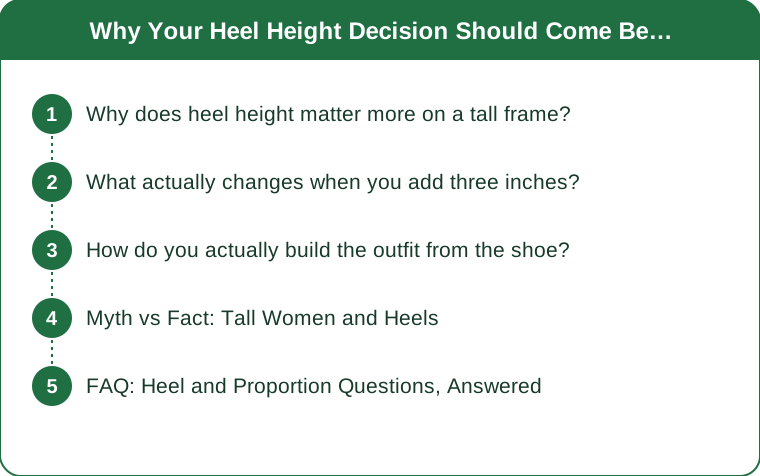
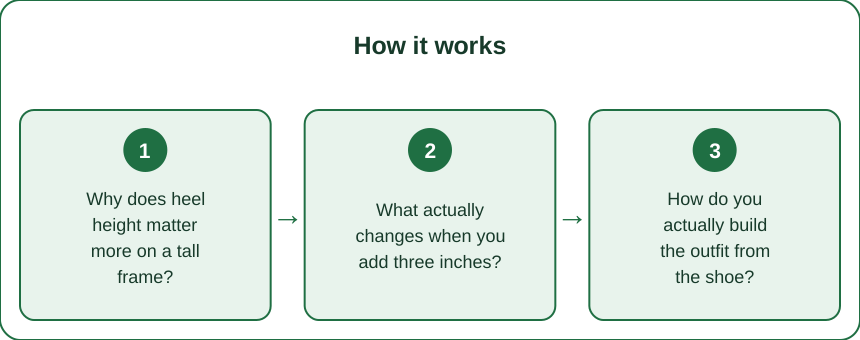
Why does heel height matter more on a tall frame?
Because you are usually working closer to the limits of a garment’s intended proportion.
A hem that falls at mid-calf on an average frame may already sit above the widest part of the calf on a tall one. Adding a three-inch heel raises the hem relative to your leg again and shifts it to the narrowest, most awkward point just below the knee.
Proportion works the same way. Most garments are designed around a rough ratio between the length of the leg shown and the length of the body above it. On a tall frame that ratio is already shifted toward the leg. A high heel pushes it further, which can be exactly what you want for a column look, and exactly wrong for a look that depends on balance between top and bottom.
There is also the plain social calculation, which is worth naming rather than pretending away: many tall women make deliberate decisions about heel height depending on the evening. That is a legitimate input, and it is far easier to make that decision first than to discover it after the outfit is assembled.
What actually changes when you add three inches?
Four things, and only one of them is obvious.
The hem rises relative to your leg by roughly the heel height, which for a midi is the difference between hitting the slimmest part of the calf and hitting the widest.
Your posture changes. A heel tilts the pelvis forward slightly and shifts weight to the forefoot, which alters how a fitted waist sits and how a jacket hangs. Fitted garments genuinely look different in heels, which is why tailors ask what shoes you will wear.
Your stride shortens, which changes how a full skirt or wide trousers move. Wide-leg trousers cut for flats will drag in flats and swing incorrectly in heels.
The visual weight of the shoe changes. A delicate strappy heel disappears and lengthens the leg; a chunky block heel or a boot adds visual mass at the bottom of the outfit and needs a corresponding weight up top.

How do you actually build the outfit from the shoe?
Start with the evening, then the shoe, then the hem, then everything else.
Decide from the evening. How much walking, what surface, how long standing, whether you will be sitting at a bar or at a table. A cobbled street and a two-hour standing reception rule out several categories before styling begins.
Choose the shoe. Commit to it. Put it on.
Now check hems, in the shoes. Try dresses and trousers on with the actual shoes rather than barefoot. This one habit removes the majority of last-minute outfit collapses.
Then choose the top half to balance the shoe’s visual weight. Delicate heel, anything above. Chunky boot, something with structure or volume up top.
A practical wardrobe note: for a tall frame, owning one excellent flat and one excellent mid-height heel — around five to seven centimetres — covers far more evenings than owning three high heels. The mid-height is the most useful shoe in a tall woman’s wardrobe and the one most often skipped.
Myth vs Fact: Tall Women and Heels
Myth: Tall women should avoid heels. Fact: This is a preference, not a rule, and plenty of tall women wear the highest heels in the room to great effect. The only genuine constraints are comfort and the evening’s logistics.
Myth: Flats always read as casual. Fact: A sharp pointed flat, a good loafer or an elegant boot all read as considered. What reads casual is a trainer-adjacent silhouette, not a low heel.
Myth: A block heel is always more comfortable. Fact: Comfort depends far more on heel-to-toe pitch and forefoot width than on heel shape. A well-made stiletto with a low pitch can be more comfortable than a badly made block heel.
Myth: You can adjust the outfit around the shoes at the last minute. Fact: You can adjust accessories at the last minute. You cannot adjust a hem, which is precisely why the shoe belongs at the start of the process.
Myth: The heel should match the formality of the venue. Fact: It should match the floor of the venue at least as much. Grass, cobbles, decking and metal stair treads have ended more evenings than dress codes ever have.
FAQ: Heel and Proportion Questions, Answered
What hem length is most flexible across heel heights?
A hem that ends just below the knee or at the ankle is far more forgiving than a true mid-calf, because both sit at a naturally narrow point and stay there through a couple of inches of heel change.
Should I have dresses hemmed for a specific shoe?
For anything you will wear repeatedly, yes — and tell the tailor which shoe. For a versatile piece, hem it to your mid-height shoe, which is the compromise that works either side.
How do I make flats work for a dressy evening?
Proportion and material. A pointed toe, a sleek leather or satin finish, and a slightly shorter or more structured hem than you would wear with heels. The flats are not the problem; a hem cut for heels worn with flats is.
TL;DR:
- Heel height changes hem placement, proportion, posture and stride simultaneously — it is a structural decision, not a finishing one.
- On a tall frame, a two-inch difference can move a hem from the narrowest to the widest part of the calf.
- Decide from the evening, then the shoe, then check hems in those shoes, and build the top half to balance the shoe.
- The most useful shoe in a tall wardrobe is an excellent mid-height heel, and it is the one most often missing.
Everything else in the outfit is adjustable in the last five minutes. The shoes are the one thing that quietly decides the rest, so they should go first.
Keep Reading
This article is for general informational and styling purposes only. Fit, sizing, and product availability may vary.