Why a Dress That Fits Everywhere Else Still Slips at the Shoulder
Quick Answer: Shoulder seams drop because most dresses are graded from a fit model with a shorter torso and narrower shoulder-to-shoulder measurement, and length added for tall sizing goes into the body of the dress rather than into the armhole and shoulder. A dropped seam collapses the whole line: the sleeve reads too long, the neckline gapes, and the bust point sits low. It is the single most visible fit fault on a longer frame and the cheapest one to have altered.
An inch at the shoulder changes more than three inches at the hem.
This blog has covered the proportion rule that makes any tall outfit look deliberate, the one detail that makes a casual outfit look unfinished, and why bar seating exposes a hem that worked standing up. This is the detail people notice without knowing what they are noticing.

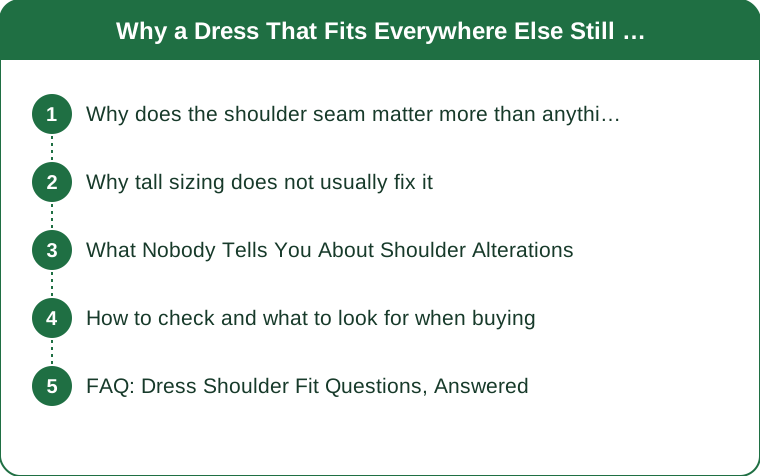
Why does the shoulder seam matter more than anything else?
Because everything about a garment hangs from it.
The shoulder is the only structural support point in most dresses. The waist, the bust and the hem all sit where they sit because of where the shoulder is.
A dropped seam lowers the whole garment. The bust point moves down, the waist seam moves down, and the hem falls slightly differently on each side if the drop is uneven.
The armhole distorts. A shoulder seam sitting on the upper arm pulls the armhole out of shape, which is why the sleeve then looks both too long and slightly twisted.
Necklines gape as a direct result. A neckline is drafted to sit correctly relative to the shoulder point, and moving that point outward opens the neckline forward.
The eye reads shoulders as the frame for the whole outfit. Which is why an outfit with a perfect hem and a dropped shoulder still looks slightly wrong and nobody can say why.
And on a longer frame it is more visible, not less. More vertical distance between the shoulder and the waist means more space for the error to show.
Why tall sizing does not usually fix it
Because tall grading adds length in the wrong places for this particular problem.
Tall grades typically add to the torso length, the sleeve and the hem. Shoulder-to-shoulder width and armhole depth are frequently left unchanged.
Shoulder width does not track height reliably. Two people of the same height can differ by four centimetres across the shoulders, and grading rules cannot capture that.
Broad-shouldered tall frames are the worst served, because sizing up to get shoulder width brings a waist and bust that are then too large.
Some tall ranges genuinely do adjust the armhole, and those are the ones worth remembering by name.
Knit dresses hide it and woven dresses expose it. A jersey dress will drape over a dropped seam; a structured woven will show it from across the room.
And the fix is at the shoulder in both cases. Which is fortunate, because a shoulder alteration is one of the more straightforward things a tailor does.

What Nobody Tells You About Shoulder Alterations
A shoulder adjustment is often cheaper than a hem. Taking up a shoulder seam on a simple dress is a modest job, and it transforms far more of the garment than shortening a hem does.
It also shortens the sleeve automatically. Lifting the shoulder raises the whole sleeve, which frequently solves two problems in one alteration.
Sleeveless dresses are the easiest of all. No sleeve head to reset means the job is quick, and the improvement is dramatic.
Set-in sleeves cost more and are still usually worth it. The sleeve has to be removed and reset, which takes time, and the visual difference is the largest of any common alteration.
Buy for the shoulder, alter everything else. This is the reverse of most people’s instinct, and it is what tailors advise. Waists and hems come in easily; shoulders do not go outwards at all.
And check the seam position in a photograph rather than a mirror. A phone photo from the front shows the shoulder line far more honestly than a mirror does, because you stop unconsciously adjusting your posture.
How to check and what to look for when buying
Six checks, about thirty seconds each.
Find your shoulder point. Run a finger along the top of your shoulder to the bony end where the arm begins. The seam should sit within about a centimetre of that point.
Check both sides. Most people have one shoulder slightly lower, and a dress will hang differently on each. Fit the higher one and let a tailor handle the difference.
Raise your arms halfway. If the whole dress lifts and does not settle back down, the armhole is too low as well as the shoulder being too wide.
Look at the neckline from the side. Gaping at the front with a correct-feeling bust is almost always a shoulder problem, not a bust one.
Prefer styles that forgive it when you cannot alter — raglan sleeves, halter necks, wrap dresses and anything with a deliberately dropped shoulder built into the design.
And take the photo. Front and side, arms down, standing normally. It is the fastest fit diagnostic available and it costs nothing.
One buying rule worth keeping: if a dress fits the shoulder and is loose everywhere else, buy it. If it fits everywhere else and is loose at the shoulder, think hard — that is the one measurement a tailor cannot add.
FAQ: Dress Shoulder Fit Questions, Answered
Where should a shoulder seam actually sit?
At the bony point where the top of your shoulder meets your arm, within about a centimetre. Sitting down the upper arm means the garment is too wide across the shoulders, regardless of how the rest of it fits.
Can a tailor fix a dropped shoulder seam?
Yes, and it is one of the highest-value alterations available. Sleeveless dresses are quick and inexpensive; set-in sleeves cost more because the sleeve must be reset, but the visual improvement is the largest of any common adjustment.
Why does my neckline gape when the bust fits?
Usually because the shoulder seam is too far out, which pulls the neckline open at the front. Correcting the shoulder normally closes the neckline without touching the bust at all.
TL;DR:
- Everything in a dress hangs from the shoulder seam, so a dropped seam moves the bust, waist and hem with it.
- Tall grading adds torso and hem length, not shoulder width, which is why a tall size often does not fix it.
- Buy for the shoulder and alter the rest. Waists come in easily; shoulders do not go out.
- Check with a phone photo rather than a mirror. Posture lies in mirrors.
An inch at the shoulder is worth three at the hem, and it usually costs less to fix.
Keep Reading
This article is for general informational and styling purposes only. Fit, sizing, and product availability may vary.