Why Wide-Leg Trousers Need a Different Shoe When You're Tall
Quick Answer: Wide-leg trousers are designed to fall from the hip in one uninterrupted line, and that line only works if the hem reaches the right point relative to your shoe. On a longer leg, the same off-the-rack length lands higher, exposing more ankle and breaking the line — so the shoe has to close the gap. A slightly higher heel or a shoe with more visual weight restores it; a delicate flat cannot.
Same trousers, same brand, and on you they look like they are waiting for a hem. That is a length-and-shoe relationship, not a fit problem.
What is the line wide-leg trousers are trying to make?
One continuous vertical from waist to floor, with nothing interrupting it.
The whole effect of a wide-leg trouser depends on uninterrupted length. The fabric falls straight from the hip, the width hides the leg entirely, and the eye reads one long column rather than a top half and a bottom half. That is where the elongating, deliberate look comes from.
The line breaks wherever the fabric stops and something else begins. If the hem ends well above the shoe, you get a visible band of ankle, then a shoe — three segments where the design intended one. The taller you are, the more of that band you get, because the trouser was cut for a shorter inseam.
Off-the-rack wide-leg trousers are typically cut for someone between 5’4 and 5’7, often with the assumption of a modest heel. On a 5’10 frame the same garment reads as cropped, and cropped wide-leg is a completely different look with completely different shoe requirements.
This is why the shoe carries more weight for you than for a shorter person. They are choosing a shoe to complement a line that already works. You are often choosing a shoe to complete a line that is a couple of inches short.
The target, when the trousers are the right length: the hem should graze the top of the shoe or just brush the floor at the back, with a very slight break at the front. That is the position that makes the column read as one piece.
Which shoes close the gap and which widen it?
The ones with height and visual weight close it. Delicate and low ones expose it.
What works:
- A block heel of 1.5 to 3 inches. Height lifts the hem toward the intended position and adds the length the trouser is short by. A block heel also has enough visual mass to balance a wide leg — a stiletto disappears under all that fabric.
- A platform or a heeled loafer. Same effect with more stability, and the chunkier profile reads intentional under volume.
- A pointed toe, at any height. The point extends the visual line beyond the hem, which is exactly what a short hem needs.
- Knee or ankle boots with a solid heel, which handle a slightly short hem better than any other category because the shaft continues the column upward.
- A shoe in a colour close to the trouser or to your skin tone, which minimises the break at the join.
What fights you:
- Ballet flats and delicate sandals. They add no height and no visual weight, so a wide leg reads as too much fabric ending nowhere.
- Ankle straps. A horizontal strap cuts the leg at exactly the point the line was trying to continue — the single worst detail with a slightly short wide leg.
- Round-toe low shoes, which stop the line abruptly rather than extending it.
- A strongly contrasting shoe colour, which draws the eye directly to the gap you were trying to hide.
And the honest exception: a genuinely cropped wide-leg trouser, worn deliberately at mid-calf or just below, works beautifully with a flat — because now the crop is the point rather than an accident. The failure only happens in the ambiguous zone, where the hem lands somewhere between cropped and full and reads as neither.
How do you get the length right in the first place?
Buy long and hem to your shoes, which is the reverse of how most people shop.
Decide the shoe first. A wide-leg trouser hemmed for a 3-inch heel is unwearable flat, and vice versa — the length difference is the entire look. Most people who wear wide-leg well own the trousers hemmed for one specific shoe height.
Then buy the longest version available. Tall ranges, extra-long inseams, or simply the longest standard length, and have it taken up. Hemming is inexpensive and it is the single highest-return alteration in a wardrobe. Fabric can always be removed and never added.
Measure properly:
- Put on the shoes you intend to wear with them.
- Stand normally, not stiffly.
- The hem should just touch the top of the shoe at the front and be a fraction longer at the back — a slight angle is standard on a wide leg and it stops the front from puddling.
- For a floor-grazing look, aim for a quarter to a half inch off the ground at the back.
Where to find length without alterations: Tall ranges are the obvious first stop, and beyond them, men’s-cut or unisex wide-leg trousers, palazzo styles designed to be floor-length, and anything described as full-length on a tall model. Brands that publish the model’s height and the size she is wearing are giving you the most useful data point available.
And two rise notes. A high rise makes the column longer and works strongly in your favour — the trouser starts higher, so the proportion of leg-to-torso reads better. A low or mid rise on a long torso puts the widest part of the trouser in an awkward place, and no shoe fixes that.

What Nobody Tells You About Tall Proportions in Wide Legs
Fabric weight matters more than cut. A heavier fabric — wool crepe, twill, a substantial viscose — hangs straight and holds the column. A thin, drapey fabric clings and flutters, and on a longer leg there is more of it doing that. The same style in two fabrics is two different garments, and the heavier one is almost always the more flattering on a tall frame.
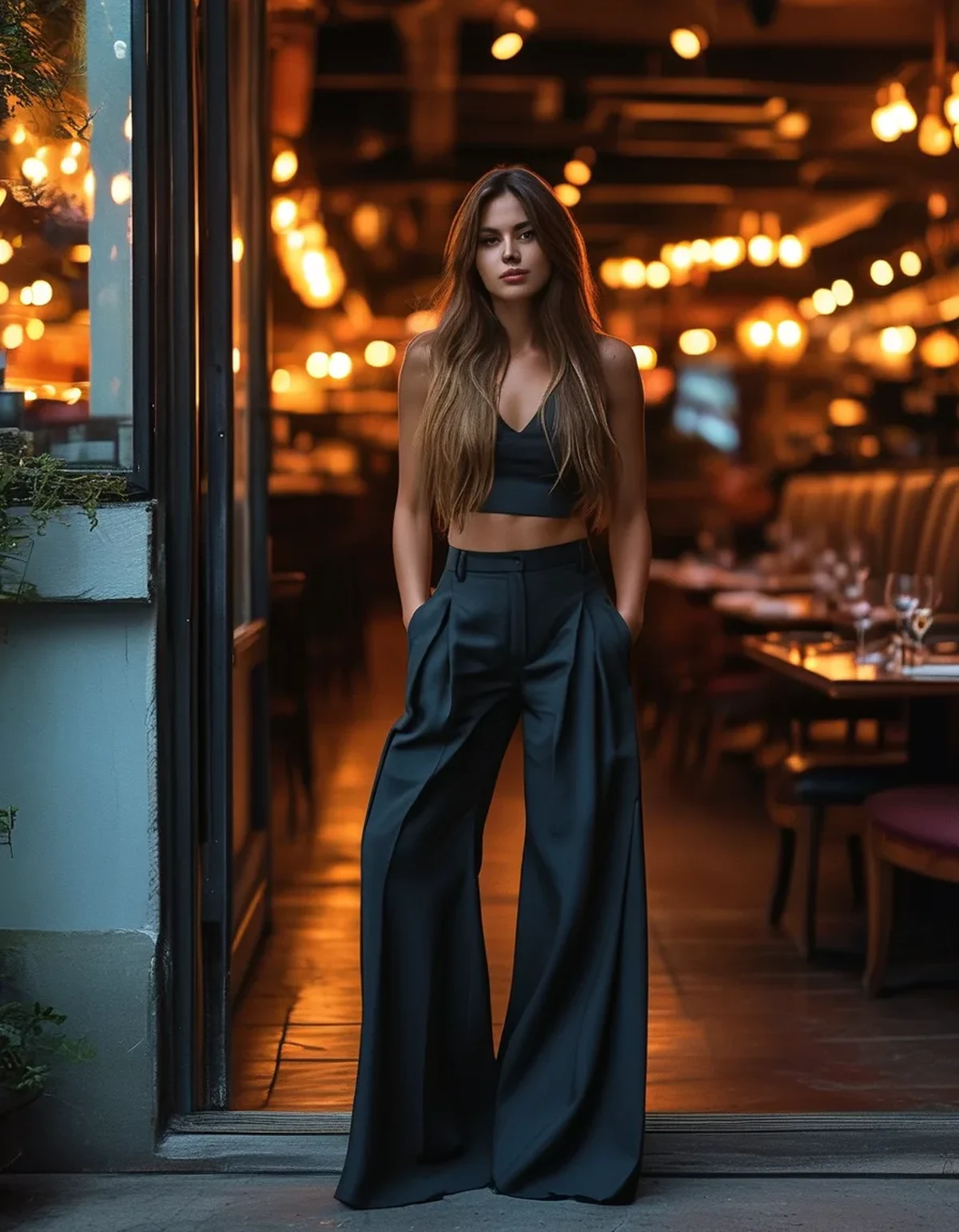
Volume needs a counterweight up top. A wide leg is a lot of fabric, and on a long frame there is more of it. A fitted or tucked top is not just a style preference — it defines where your waist is, which the trousers alone will not do. An untucked loose top with a wide leg removes every reference point and reads as fabric rather than an outfit.
The waist marker is the whole outfit. Tucking, a belt, or a cropped top gives the eye a place to divide the column and makes the leg length read as deliberate. Without it, tall plus volume plus volume reads shapeless regardless of quality.
Your inseam is not the only variable — your knee position is. On a long leg the knee sits lower, which changes where a trouser’s widest point falls. This is why a style described as flaring from the knee flares from further down on you, producing a narrower silhouette than the design intended. Styles that flare from the hip are more predictable on a tall frame.
Sitting exposes the hem you got away with standing. A slightly short wide leg rides up substantially when you sit, and dinner is mostly sitting. Check the hem seated before committing to an outfit for a restaurant — it is the single most common way an outfit that worked in the mirror stops working at the table.
And the effect is amplified in photographs. A camera flattens depth and exaggerates the horizontal break at the ankle. An outfit that looks fine in a mirror can read distinctly unfinished in a photo, which for a date night is worth knowing in advance.
What does the finished outfit look like?
Three combinations that work reliably, with the reasoning attached.
The dinner version. High-rise wide-leg trousers in a heavier fabric, hemmed to graze a 2 to 3 inch block heel. A fitted knit or a tucked silk top. The heel closes the length gap, the block gives it enough weight under the volume, and the tuck marks the waist. This is the most reliably good version of the look for a tall frame.
The flat version, done properly. Wide-leg trousers hemmed specifically for flats, with a pointed flat or a loafer with some substance. The point extends the line where height cannot. Fitted top, tucked. The key is that the hem was cut for this shoe — a hem cut for heels worn with flats is where the look goes wrong.
The boot version, which is the autumn answer. Wide-leg trousers over a heeled ankle or knee boot, hem grazing the top of the boot. The boot shaft continues the column, which makes this the most forgiving option for a hem that is slightly short — and it is the reason wide-leg trousers get easier to wear as the season turns.
Across all three:
- Define the waist, by tuck, belt, or a shorter top.
- Keep the shoe close in tone to the trouser or to your skin.
- Avoid ankle straps unless the hem genuinely covers the ankle.
- Check the hem seated before you leave.
And own one pair properly rather than three approximately. A wide-leg trouser hemmed to your shoe, in a fabric with weight, at a high rise, is one of the strongest pieces available to a tall frame — the length that fights you in most clothing is the exact thing this silhouette needs. It just needs to reach the floor.
FAQ: Tall Women and Wide-Leg Trousers, Answered
Can I wear wide-leg trousers with flats at all?
Yes, provided the hem was cut for flats. The failure is not flats themselves, it is a hem set for a heel worn without one, which leaves a gap. A pointed flat or a loafer with some visual weight, plus a hem that grazes the top of the shoe, works well — and a fitted or tucked top matters more here than in the heeled version.
How long should wide-leg trousers be?
With the shoes you plan to wear, the front hem should just touch the top of the shoe and the back should sit a fraction lower — a quarter to a half inch off the floor for a grazing look. If you are between shoe heights, hem for the lower one, because a slightly long trouser reads intentional and a slightly short one does not.
Do I need a different rise as a tall woman?
A high rise generally serves a long frame much better, because it lengthens the column above the widest part of the trouser and gives you a clear waist. A long torso with a mid or low rise puts a lot of vertical distance between the waist and where the volume starts, which is the proportion most people find hardest to style.
TL;DR:
- Wide-leg trousers work by making one uninterrupted vertical line, and a short hem breaks it into three segments
- Off-the-rack lengths are cut for 5’4 to 5’7, so on a longer leg they read cropped rather than full
- Block heels, platforms, pointed toes, and boots close the gap; flats, round toes, and ankle straps expose it
- Buy long and hem to one specific shoe height, in a fabric with enough weight to hang straight
- Define the waist with a tuck or belt, keep shoe tone close to the trouser, and check the hem sitting down
Wide-leg is one of the few silhouettes that actively wants the length you have. Get the hem to the floor with a shoe that has some weight to it, and it stops looking unfinished and starts looking like the reason the style exists.
See It in Motion
Seen here: High Waist Drawstring Wide Leg Yoga Pants with Pockets — shop it on bubblelime.com
Keep Reading
This article is for general informational and styling purposes only. Fit, sizing, and product availability may vary.