Why a Tall Woman's Coat Decides the Whole Date Night Outfit
Quick Answer: On an autumn date night the coat is on for the arrival, the walk, the queue, and the departure - often more visible minutes than the outfit underneath. For tall women the two things that decide whether it works are length relative to what is under it and sleeve length, in that order. A coat that ends within a few centimetres of a dress hem creates a visual stack that shortens the whole silhouette; sleeves that end above the wrist bone undo an otherwise perfect outfit instantly.
Here is how to get both right.
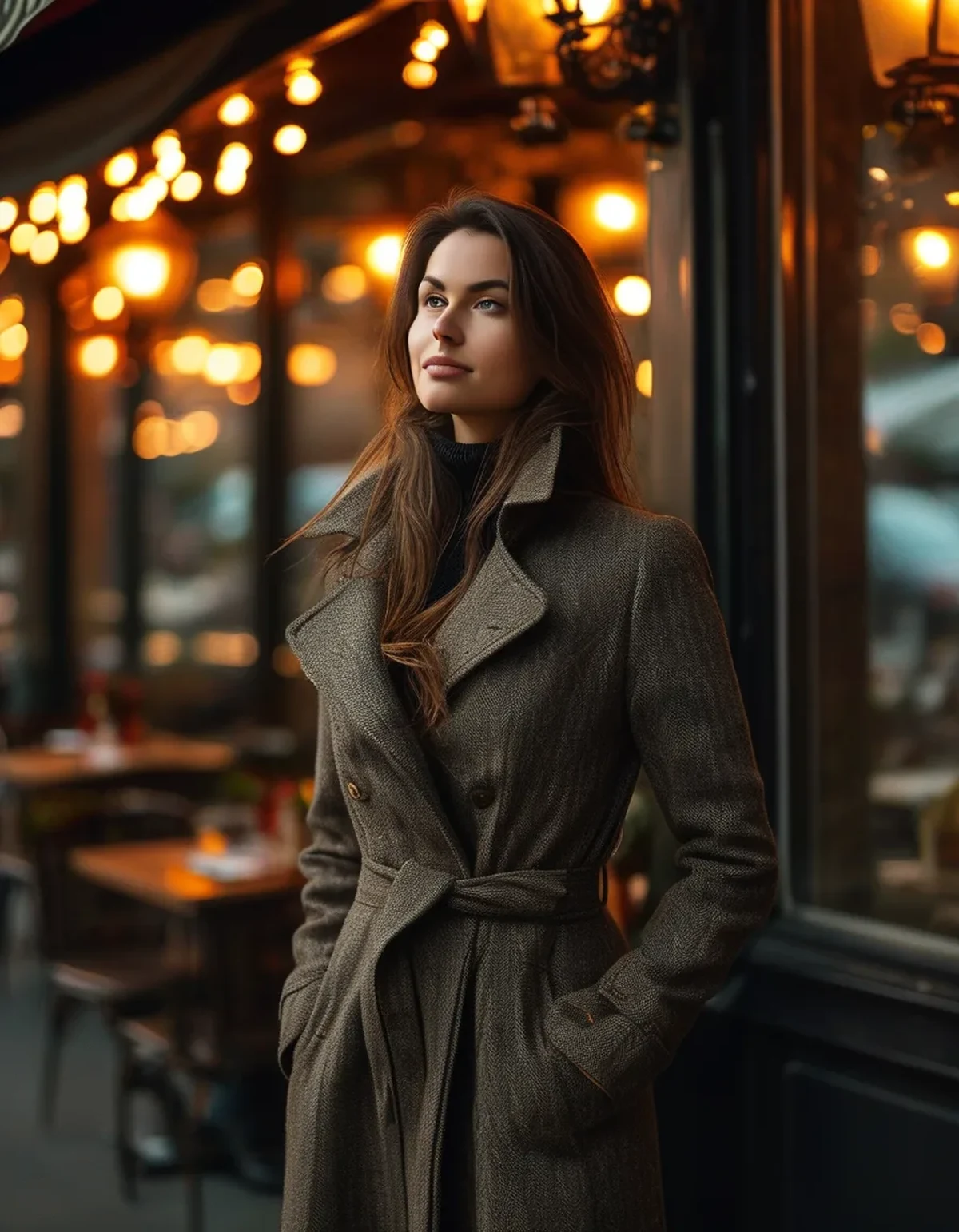
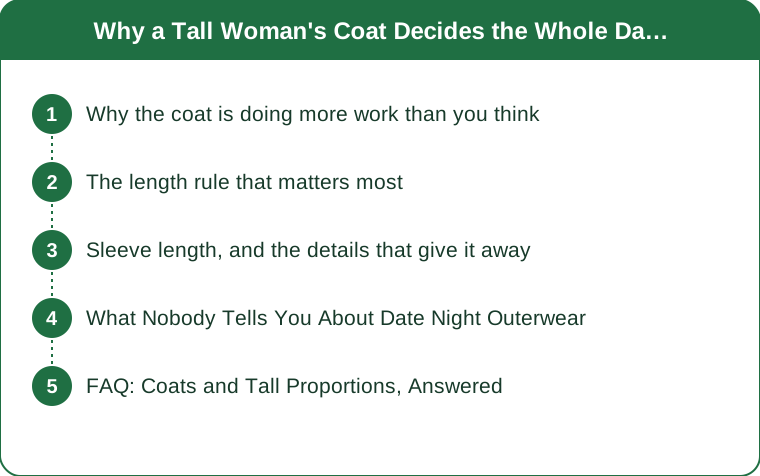
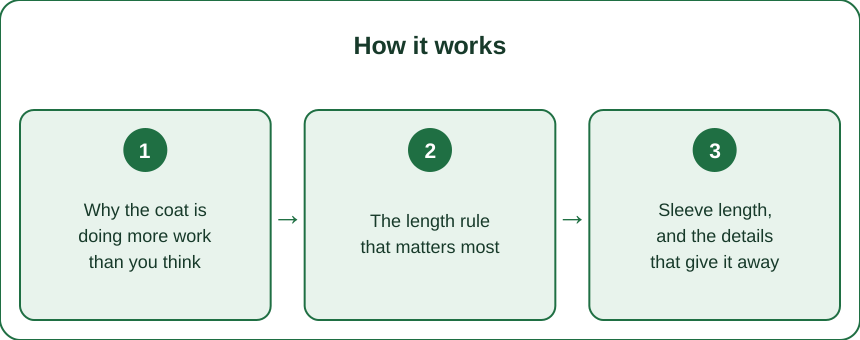
Why the coat is doing more work than you think
Count the minutes. Arrival, the walk from the car or the station, waiting to be seated, stepping outside, and the journey home. On an autumn evening that is frequently more time coated than uncoated.
It is also the first impression. Whoever you are meeting sees the coat before anything else, and first impressions are formed in the doorway rather than at the table.
For tall women the coat has extra leverage because it covers the majority of a longer frame. A coat that is proportionally wrong dominates the silhouette in a way it does not on a shorter frame.
Photographs are usually taken outside. The picture from the evening is very often the coated one, taken on a street or at a doorway rather than at the table.
And it is the piece most likely to be an afterthought. People plan the dress, the shoes, and the bag, then wear whatever coat is by the door - which is the entire problem this article exists to solve.
The length rule that matters most
The coat should either clearly cover what is underneath or sit clearly above it. The failure mode is the near-miss: a coat ending within a few centimetres of a dress hem, which creates a stacked double line and visually chops the leg.
Clearly longer is the safer choice for tall women. A coat that ends below the knee or at mid-calf over a shorter dress reads as deliberate, and long lines are a tall frame’s advantage rather than a problem.
Clearly shorter also works - a cropped or hip-length jacket over a long dress creates a strong horizontal at the hip and lets the dress do the vertical work. This is the more fashion-forward option and it is genuinely flattering.
The zone to avoid is roughly five centimetres either side of the hem underneath. That is where the two lines compete, and neither reads as intentional.
Maxi over maxi needs care. A full-length coat over a full-length dress can look excellent provided the coat is slim or open, and heavy if it is voluminous.
And check it seated as well as standing. A coat draped over the back of a chair is fine, but if you keep it on in a cool restaurant the seated proportion is what people see for two hours.
Test it in a full-length mirror with the actual shoes on. Heel height changes hem relationships by several centimetres, which is enough to move a coat from clearly-longer into the competing zone.
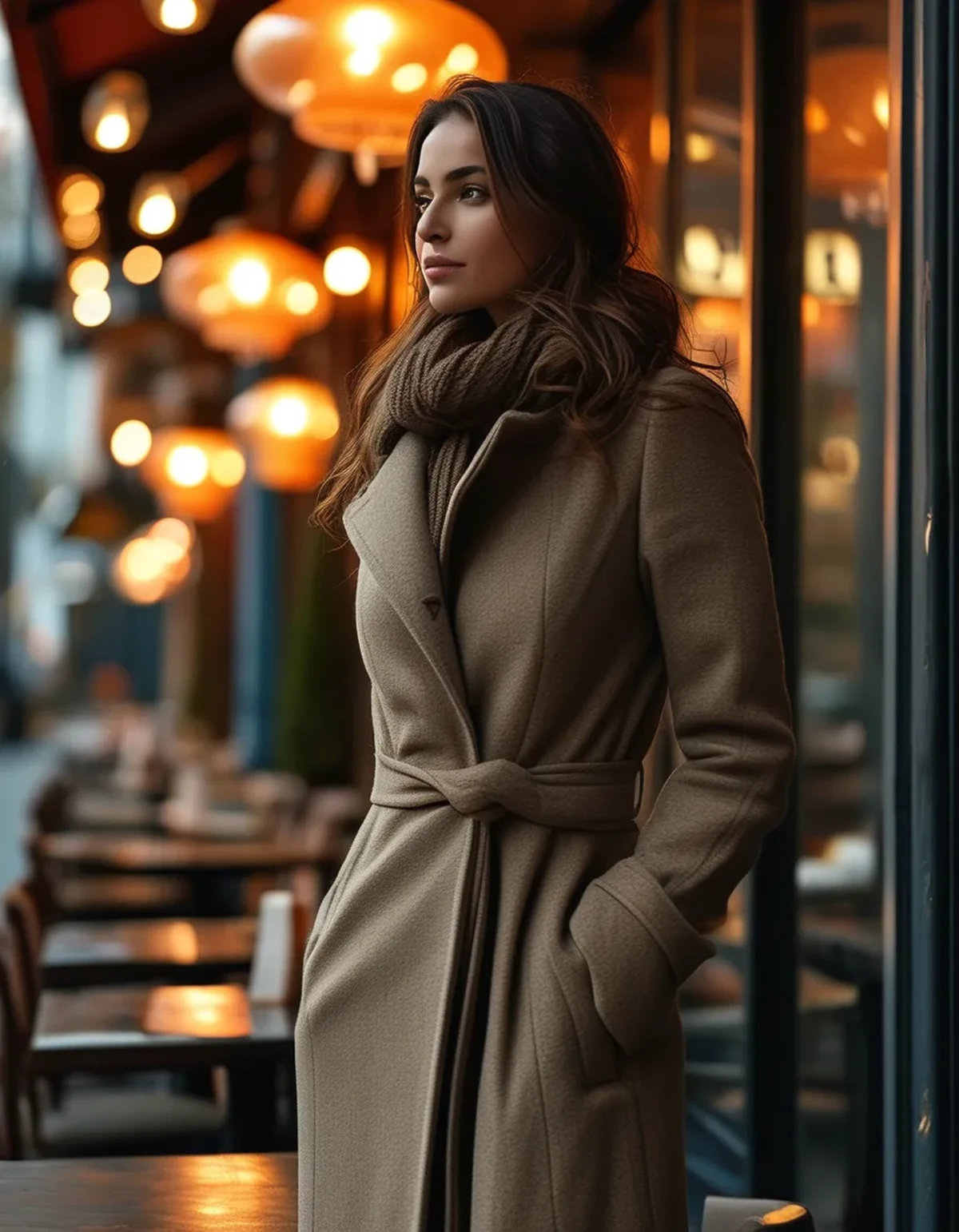
Sleeve length, and the details that give it away
Sleeves should cover the wrist bone, ideally reaching the base of the thumb when the arm hangs. This is the single most common tall-woman coat failure and it is instantly visible.
Sleeves that ride up when you raise an arm - reaching for a door, a glass, a handrail - are the version people miss in the shop. Check it with your arm extended forward, not hanging.
Buy for the sleeve and alter the body, applying the same hierarchy that governs tailoring generally. Lengthening a sleeve is limited to the existing allowance, usually two to four centimetres.
A cuffed or turned-back sleeve buys you options. Coats with a functional turn-back can often be worn unturned for extra length, which is a quiet advantage worth looking for.
Watch the button placement on double-breasted coats. The button rows create a strong horizontal, and on a long torso they frequently sit too high, which shortens the visual torso.
Belt position is the other giveaway. A belted coat with the belt loops set for average proportions puts the belt above your natural waist, which is unflattering on almost everyone. Some coats allow the belt to be worn lower through the loops or without them.
And pockets should sit at the hand. Pockets set too high force the elbows out and up when you use them, which is both uncomfortable and visible.
What Nobody Tells You About Date Night Outerwear
Restaurants are colder in September than in December because the heating is not on yet. The coat you keep on is a genuine consideration in early autumn in a way it is not mid-winter.
A coat you cannot sit in comfortably will come off, which changes the outfit calculation entirely. Try sitting down in it in the shop - stiff, structured coats often do not allow it gracefully.
The lining matters for how it moves. A slippery lining lets a coat slide over a dress; an unlined or textured lining catches and rides up, bunching over the hips.
Colour contrast makes proportion errors more visible. A coat that contrasts sharply with what is underneath draws attention to exactly the line where they meet. Tonal combinations are more forgiving while you work out what length works.
Bag and coat need to agree. A cross-body strap over a heavy coat compresses the silhouette across the torso and, on a long torso, sits at an awkward height. A hand-carried bag avoids the whole problem.
Scarves need to be longer than average to work. A standard scarf on a tall frame ends too high and looks scant, which is the same problem as a short sleeve in a different place.
And the shoes must survive the walk. The coat is a walking-outside piece, which means the outfit under it includes a shoe that works on a pavement - the most common autumn date night regret.
Buy the coat in early autumn, not in November. Selection is best now, and tall sizing sells out first in outerwear as in everything else.
FAQ: Coats and Tall Proportions, Answered
What coat length works best for tall women?
Either clearly longer than what is underneath - below the knee or mid-calf - or clearly shorter, like a cropped or hip-length jacket. The zone to avoid is within about five centimetres of the hem underneath, where the two lines compete.
How long should the sleeves be?
Covering the wrist bone and ideally reaching the base of the thumb when the arm hangs. Check with the arm extended forward as well as hanging, since sleeves ride up when you reach.
Can coat sleeves be lengthened?
Only as far as the existing allowance, usually two to four centimetres. Buy for the sleeve and have the body altered instead - waist shaping is routine work.
Why does my belted coat look wrong?
The belt loops are usually set for average proportions, so on a long torso they place the belt above your natural waist. Some coats let you wear the belt lower or without the loops.
Should the coat be tonal with the outfit underneath?
While you are working out what length works, yes - sharp contrast draws attention to exactly the line where the two pieces meet. Once the proportion is right, contrast is fine.
Does it matter if I take the coat off indoors?
More than people expect in early autumn, because restaurants are often cooler in September than in mid-winter. Try sitting in the coat before buying - a coat you cannot sit in gracefully will come off.
When should I buy an autumn coat?
Early autumn. Selection is at its best now and tall sizing in outerwear sells out first, as it does across every category.
TL;DR:
- The coat is visible for more of the evening than the outfit - arrival, walk, queue, departure, and usually the photograph.
- Length: clearly longer or clearly shorter. Avoid the five-centimetre zone either side of the hem underneath, where the lines compete.
- Sleeves to the wrist bone, ideally the base of the thumb. Check with your arm extended, not hanging.
- Buy for the sleeve, alter the body. Sleeve lengthening is capped at the existing allowance.
- Watch belt loop height - set for average proportions, they land above a long natural waist.
- Tonal is forgiving while you work out what length works; contrast highlights the meeting line.
- Try sitting down in it. September restaurants are often cooler than December ones, so you may keep it on.
Buy in early autumn. Tall sizing in outerwear sells out first, and the selection now is the best it will be.
Keep Reading
This article is for general informational and styling purposes only. Fit, sizing, and product availability may vary.